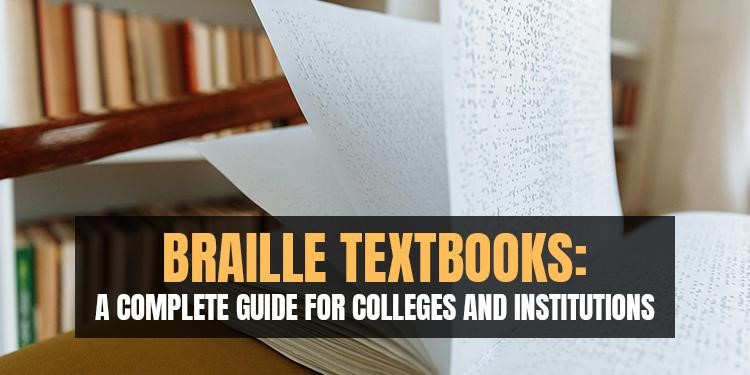
Classrooms are meant to be places where every student can learn, discover ideas, and build confidence. For students with visual impairments, the learning experience often depends on a single crucial element: access to the right teaching tools.
Textbooks are at the center of academic life. They offer instruction, help to help students understand concepts, and encourage individual learning. If resources aren’t readily available, students must use other sources that may not support their learning. This could impact their understanding and self-confidence.
This is the moment when braille textbooks are essential. They are a simple and safe way for students to communicate with the academic materials. For colleges and institutions, investing in accessible educational materials doesn’t just mean meeting standards; it also supports students’ learning. It’s about creating an environment that gives every student the same chance of success.
Understanding the Role of Braille in Higher Education
Braille is much more than a reading system. It’s a tool that lets you be independent. In higher education, where students are expected to think critically, comprehend, and apply knowledge, access to a structured reading resource becomes essential.
Students who depend on braille require materials that are compatible with the complexity and depth of their classes. Audio aids can help students learn, but they usually fall short in deep study. Reading allows students to work at their own pace, revisit sections, and deepen their understanding of the topic.
By providing accessible textbooks, institutions ensure that students aren’t restricted by their format. Instead, they can take full advantage of the academic environment, including classes, exams, assignments, and even research.
What Makes Braille Textbooks Different
The process of making braille textbooks isn’t like changing text word-for-word. It’s a procedure that requires meticulous planning and a thorough understanding of how reading works.
Unlike printed books, braille documents are read by touch. This means the layout, spacing, and content arrangement need to be modified. Paragraphs, headings, and sections need to be clearly identified to ensure readers can navigate the layout without visual clues.
Tables, charts, and diagrams require special attention. These types of elements are typically converted to simpler formats or to touch-based representations.
Because of these differences, creating top-quality braille-based textbooks requires technical knowledge and keen attention to detail. The objective is not only to translate the text, but also to improve its value and make it useful to the user.
The Process to Convert Textbooks to Braille
If institutions opt to convert their textbooks to braille, it usually comprises several phases. Each step plays a vital role in ensuring the quality and effectiveness.
First, you must understand the content’s format. This means finding chapters, headings, references, and visual elements. Once the structure is established, transcription begins. Text is converted to braille by applying the appropriate codes that correspond to the language and subject.
Following transcription, information is formatted to be read. This means organizing the material so it is easy to navigate. Sections are clearly defined, and any unnecessary complexity is minimized whenever feasible.
The final step involves proofreading and validation. Braille experts review the content to ensure it is precise and easy to understand. After this review is completed, will the content be made available in a digital or physical braille format?
This systematic approach ensures that the available educational materials comply with academic and usability requirements.
Addressing Challenges in Academic Content
One of the greatest challenges in creating braille books is the complexity of the academic content. Mathematical subjects like engineering and science contain equations, symbols, and diagrams that aren’t simple to translate.
For instance, mathematical equations should be interpreted according to specific braille codes to provide clarity. Diagrams from scientific research may have to be recreated in tactile images. This requires expertise and patience.
Another issue is the sheer volume of content. Colleges typically require numerous textbooks across different fields, and each has its own specific formatting requirements. Making these demands work within timeframes can be a challenge.
This is why many institutions rely on expert assistance to manage the process. Expertise from professionals ensures that even the most complex materials are transformed efficiently and precisely.
The Importance of University Braille Services
To ensure accessibility, many institutions turn to braille at the university level. These university braille services serve as a bridge between academic material and accessible formats.
They help institutions plan, prioritize, distribute, and deliver braille documents systematically. This includes converting textbooks, creating exam materials, and helping faculty develop accessible materials.
The availability of dedicated services also helps ensure consistency. Students are provided with materials that adhere to the same guidelines across all disciplines, which makes it easier to learn and master.
Additionally, they make accessibility an ongoing process instead of a one-time event. This results in more positive outcomes for students and the institutions.
Enhancing Student Experience Through Accessibility
If students have access to prepared braille resources, their impact is felt immediately. They can read independently, prepare for tests with confidence, and actively engage in class discussions.
This autonomy helps to reduce the need for constant help. This also lets students be in charge of their own learning experience.
Over time, it leads to better academic performance and greater confidence. They are also more inclined to remain active, continue their studies, and pursue career options.
Providing braille-friendly textbooks isn’t just about accessibility. It’s about enabling growth in confidence and long-term achievement.
Institutional Benefits of Investing in Accessibility
Accessibility is often seen as a necessity, but it can also bring substantial benefits to institutions. Colleges that invest in accessible educational resources create welcoming, progressive environments.
These institutions are better equipped to draw diverse student groups. They also show a commitment to equality of opportunity, which improves their standing.
Additionally, accessibility initiatives can lead to improved teaching methods. Faculty members are more aware of the different learning needs and adjust their teaching methods accordingly.
Over time, this can create an empowering and efficient educational environment that benefits all pupils.
Final Thoughts
Accessible education starts by gaining access to information. For visually impaired students, this accessibility is made possible by carefully designed braille materials that support independent learning.
Institutions that make investments in braille books and have reliable accessibility systems do not just meet the requirements. They create environments where students can study without difficulty and realize their full potential.
Organizations such as Braille Music and More help institutions and colleges create high-quality, well-structured, and easy-to-use braille documents. From textbooks and academic resources to professional services, ensure materials are easy to access and effective.
If your school is ready to tackle accessibility with seriousness, this is the perfect time to get started. Collaborate with experts who know accessibility and education, and create an environment that gives every student the resources they require to be successful.