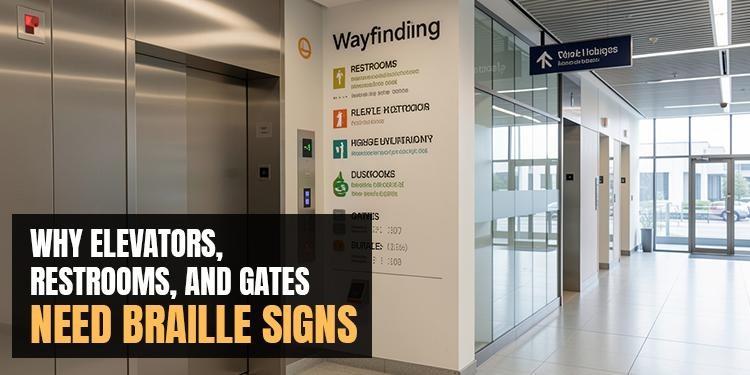
Buildings nowadays are made to move people around effectively. Restrooms provide privacy and comfort, elevators transport us between floors, and gates direct us through transit hubs and workplaces. Most people find it easy to navigate these areas. However, for people who are blind or visually impaired, navigating a building largely depends on how well the surroundings convey information through touch and sight.
Braille and tactile signage are not minor architectural accessories. People can move freely, securely, and with dignity thanks to these vital navigational aids. Even familiar places can become stressful and confusing if these signs are absent or positioned incorrectly. In practice, a seemingly insignificant design element may become a significant obstacle.
As public spaces grow larger, busier, and more complex, the need for clear, reliable tactile information becomes even more important. Elevators, restrooms, and gates are not just functional areas; they are decision points. Providing proper braille signage at these locations ensures that accessibility is built into the structure itself, rather than treated as an afterthought.
Restrooms: Supporting Privacy and Dignity
Restroom access is also a question of dignity and independence, not only of convenience. While the absence of braille signage may mean an individual does not need to ask for directional assistance, it also increases the risk of entering the wrong space.
Restroom signage offers tactile solutions that help users to:
• Identify restrooms without the need for
• Access the restroom without attracting unwanted attention
• Identify the presence of an accessible stall
• Minimize uneasiness when entering a space for the first time
Why Tactile Restroom Signs Enable Independent Use
Tactile restroom signs play a crucial role in helping individuals with visual impairments navigate public spaces with confidence. Without clear touch-readable indicators, something as basic as locating a restroom can become stressful, confusing, or even unsafe.
Properly designed braille and tactile signage removes this uncertainty by allowing users to identify facilities quickly and independently.
When restroom signs include accurate braille, raised lettering, and consistent placement, they help users to:
- Confirm they are entering the correct restroom
- Locate facilities without needing to ask for help
- Maintain privacy in sensitive spaces
- Feel more secure in unfamiliar environments
Inclusion in design is often reflected in small details. Tactile restroom signage may seem simple, but it directly supports dignity, independence, and ease of movement within a building.
Gates and Entry Points: Guiding Safe Navigation
Entry points, boarding areas, and security checks are often places where people must move quickly and deliberately. Uninterrupted flow is critical, and clear signage is key to eliminating user confusion and delays. To promote independent travel, they also offer touch-based info to confirm their destination.
Gate braille provides users with the ability to:
- Validate an entrance or gate number
- Braille directs them
- Be on time for their flights or appointments.
- Sense less anxiety when navigating busy areas
In a crowded space, the provided reliable touch information will significantly improve the space.
Public Signage: The Importance of Uniformity
The benefit of braille signage can only be unlocked when uniformity is applied. The signage must be braille and applied to every sign.
Uniformity in a space will provide the following benefits.
- Reduction of errors
- Improve wayfinding and navigation
- Greater confidence as a user
- Predictable and Accessible environments
The correct placement of signs is important, and it is best to consult an experienced provider.
Placement and Design Influence Usability
Braille signage works best when carefully placed and designed. Even if signage is translated correctly, down, inconsistent, or unclear signage can still fail. To use tactile signage, it must be located in a predictable spot, be easily accessible, and be easily located.
Signage design should be attentive to:
- The average reach of adults to ensure all signage is touch accessible
- The average reach of adults to ensure all signage is touch accessible
- Materials that can easily be read and maintained are readable
- Signs that contain a blend of braille and print that are easily touch accessible
When design principles are utilized, tactile signage is easier to locate. This is critical for the navigation of both visitors and frequent users.
How Braille Signage Helps Everyone Navigate Better
Braille signage, while primarily for the blind and visually impaired, is a universal design that increases the usability of public space for all. Efficient and proper signage and wayfinding increase the ability to move freely and order in a space.
Signage that supports inclusivity benefits:
- Help for older adults with diminished sight
- People unfamiliar with the design of the space
- People carrying luggage who need quick direction
- People who are trying to control a crowded space
The sophisticated design of public space facilitates movement, optimizes communication, and enhances security for all.
Creating Accessible Spaces for All
With the modernizing of buildings, transit stations, and other facilities, accessibility features are expected elements in design and construction. One example is professional-quality braille signage in elevators, restrooms, gates, and other areas, which helps individuals navigate the facility independently.
Prioritizing professional tactile signage in your facility is one way to demonstrate your organization’s commitment to thoughtful design and inclusive spaces, as is partnering with a reputable firm like braille Music and More, which will ensure the signage is durable, accurate, and appropriately placed.
Including braille signage in your building design is an investment that will improve navigation and comfort within your space and enhance overall accessibility. A building is only truly functional when everyone can navigate it with ease. Don’t let accessibility gaps turn everyday spaces into obstacles. Work with trusted experts like Braille Music and More to turn accessibility into a seamless part of your design, and make your space one that people can move through confidently, independently, and with dignity.