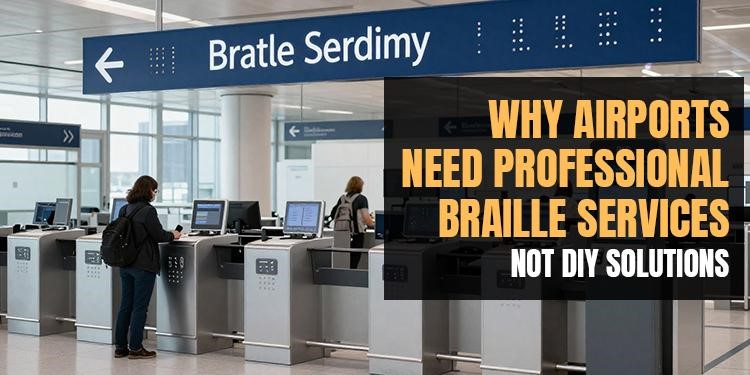
Every airport is designed for safe navigation of thousands of passengers each day. Clear tactile signage is equally important for blind and visually impaired passengers in learning how to navigate the terminals, locate what they need, and move around independently.
As air travel continues to increase, the accessibility of airport terminals is more pressing than ever. Truly accessible airports must include reliable tactile wayfinding systems. Although some airports attempt to make their own tactile signage and braille labels, DIY approaches will always be unreliable and pose safety and usability challenges. Professional braille services at airports are not a luxury – it is a necessity.
The Importance of Clear Signage in High-Pressure Environments
Airports are high-pressure environments where time is of the essence. Clear and accurate signage is critical for passengers to locate check-in counters, boarding gates, restrooms, exits, and emergency exits.
Delays and safety issues are possible when signage is poorly designed, including braille signage. Professional solutions for braille at airports enhance tactile signage and ensure compliance with safety and accessibility standards.
Well-designed braille signage allows travelers to:
– Find their desired locations
– Verify the correct gate and terminal location
– Utilize emergency exits
– Navigate independently and not rely on assistance
When professionals design accessibility, travelers will confidently navigate the entire airport.
Inaccurate Information from DIY Braille
Some businesses use simple engraving machines or other automated methods to add braille labels to their facilities. This may be a cost-saving strategy, but it may result in a variety of errors, including spacing, formatting, or braille translation issues.
Doing braille correctly involves understanding standardized braille codes, specific layout requirements, and other rules governing touch-readability.
- DIY systems frequently introduce problems such as:
- Presence of inaccurate braille symbols or contractions
- Engraved labels that are touch-readable, but difficult to read
- Formatting that is inconsistent across multiple signs
- Excessive gaps in navigational context
Inaccurate or inconsistent signage leads to the absence of the “accessible” label. Reliable braille at airports must be professionally produced to ensure that every sign is usable, readable, and consistent.
Airport Signage and Flexible Navigation
Large crowds in large open spaces demand signage that is easy to read. When the same company makes braille signs, all information across the various terminals, check-in counters, and service points is presented in the same way.
When information is presented consistently, travelers can accurately read signs without having to wonder or think about the message. With the same signs, professionally done braille means that the airport will have:
- Unified labeling systems
- Thoughtful spacing of touch signs
- Consistency in language across different sections
- Consistency in navigational prompts
- Information that is complete and easy to read
The information travelers have to deal with is consistent, and the airport experience is better as a result.
Providing Inclusive Travel Experiences
Airports are the first point of contact for many travelers with different cities, countries, and cultures around the world. Suppose accessibility features are incorporated into the airport’s design and layout. In that case, they will help provide a more positive and paperless experience for all travelers.
For example, installing braille signage gives travelers the autonomy to navigate all areas of the airport, including the departure gate. The installation of braille signage at airports in all areas will be beneficial to travelers in the following ways:
- Decreased dependency on airport staff for assistance
- Private information retrieval bypassing airport staff
- Empowered self-directed navigation between terminals
- Increased confidence in traveling through unfamiliar terminals
The spirit of inclusivity in the design of braille signage expresses a devotion to universal design and the belief that all individuals are equal and should be able to experience the designed space.
Specialized Knowledge for Durability and Reliability
Braille signs in airports are subjected to heavy traffic, frequent cleaning, vandalism, and other destructive environmental factors. Signage design and placement require professional judgment to balance factors such as material durability, sign placement, and the braille score, based on the design.
For example, a reputable firm such as Braille Music and More will understand how to create braille signage with the right structure, and high levels of accuracy, simplicity, and interpretive power. Accessibility features will be implemented to facilitate movement and access rather than create additional barriers.
Constructing Fully Inclusive Airports for the Future
With improvements in travel systems, wider recognition of sustainable access is increasing. Airports that have incorporated professional braille services demonstrate a dedication to safe and inclusive design. Touch wayfinding signs assist users with self-boarding, helping ensure that public infrastructure is accessible to all.
Access to airports extends beyond elevators and ramps. Clear and professionally produced braille signage is a necessity. Airports that use professional braille services rather than makeshift solutions foster confidence and autonomy among all users.
Air travel should be safe, clear, and independent for every passenger. If your airport is planning upgrades or new infrastructure, now is the time to move beyond temporary fixes and invest in professional accessibility solutions.
Connect with Braille Music and More that would ensure that tactile signage is accurate, durable, and designed for real-world navigation. Build accessibility into your airport today so every traveler can move with confidence tomorrow.