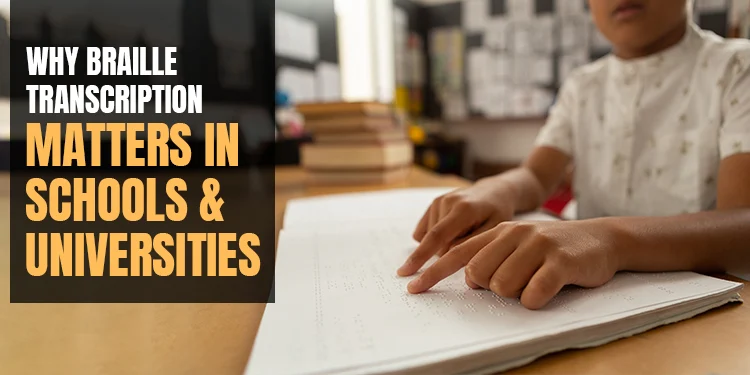
Education should empower every learner. Students who are blind or visually impaired have a right to equal access to knowledge. But traditional print materials often leave them out. Braille transcription for education provides access to the curriculum. It makes the textbooks, handouts, and tests into something readable.
This method encourages confidence and academic success. Braille access must be approached as a fundamental service in schools and universities.
Understanding Braille Transcription in Education
A Braille transcription is a process that turns printed or other digital text into braille for a tactile medium. Professional transcribers use standard braille codes that ensure uniformity and accuracy. They modify material about math, science, music, and literature. It’s also the work of someone with skills and a sense of precision. Braille transcription for education helps to ensure that children are able to obtain the same information as their friends.
Why Braille Textbooks Are Essential
Textbooks are the basis for academic study. Education is disjointed without braille materials for visually impaired students. Handheld audio isn’t truly surrogating decent tactile reading. Braille is conducive to teaching spelling, grammar, and comprehension. Learn formulas, drawings, and complex structures using Braille. Textbooks in Braille for blind students lead to improved learning. They are also suitable for self-study and exam preparation.
Supporting Accessible Learning Materials for Blind Students
Accessible instructional materials for blind students need to include more than textbooks. Classroom notes, worksheets, quizzes, and digital content also need to be modified. Braille translation ensures uniformity of textbooks and instructional materials. Students can join lessons as they happen. They are able to learn content with little intervention. Learning Media for the blind and accessibility to those materials are keys to increasing classroom participation. They also narrow learning gaps and academic frustrations.
Braille and Inclusive Education
Inclusive education braille initiatives strengthen equality in academic environments. Schools that offer braille offerings are showing respect for different styles of learning. Collaboration and respect are a natural part of inclusive classrooms. Braille access ensures that students can engage as fully in discussions and group projects. Braille practices for inclusive education are also in accordance with access laws and educational levels. These efforts foster trust between institutions and families.
Braille Transcription in Higher Education
Universities present complex academic challenges. Students are faced with graduate-level textbooks, research papers, and technical materials. There should also be braille transcribing for education; people who are blind can do well at that level as well. Transcribers used to copy graphs, equations, and references properly in transcribed text. A student may depend on Braille in coursework management. Higher education institutions that invest in braille access retain talented students. They also advocate for academic diversity and excellence.
The Need for Braille Access on time
The availability of braille materials on time is critical to academic success. Textbooks and notes that are late disrupt routines. The lessons and assignments are impossible for students to keep up with. Literacy through Braille in education should commence without delay as early into the school year as possible. Prepare ahead of time for a great classroom experience. There is also less stress on students and teachers if work arrives on time. Schools that plan ahead have a very strong commitment to access.
Technology and Braille Accessibility
Technology enhances braille transcription processes. Speed of access is enhanced by the digital braille files and refreshable displays. However, technology doesn’t by itself ensure accuracy. Formatting, context, and meaning get checked by human transcribers. Braille learning materials for blind students require not only tools, but also expertise. Institutions need to balance automation with professional quality control.
Benefits for Teachers and Institutions
Educators and entities also have much to gain from Braille transcription. You can plan your lessons safely with this knowledge. They know that all students can access the materials. Houses significantly minimize delay in accommodation and last-minute shifts. Braille Inclusive education enhances the reputation of the institution. They also demonstrate commitment to educational equity.
Challenges Without Braille Access
For students who are blind, without braille resources, they face incredibly challenging barriers. They are very dependent on others for their reading accompaniment. This reliance encroaches upon both privacy and trust. Learning is retarded without prompt supplies. Braille school books for the blind help to solve these problems. They provide educational equity and stability.
Constructing a More Inclusive Educational Future
Braille access ought to be a priority for all educational facilities. Policy makers need to work together with administrators and educators. Invest in and train for sustainable braille programs. Braille transcription for education promotes lifelong inclusion. Open systems benefit learners, now and in the future.
Preparing Students for Lifelong Success
Braille literacy prepares students to live and work independently beyond the academic setting. Effective reading skills facilitate professional communication and critical thinking. Braille textbooks for visually impaired learners build confidence early. Accessible resources for blind students are essential in developing lifelong learners. Education systems that provide access to braille prepare students for future success.
Community Impact and Awareness
Braille-savvy promotes disability rights and inclusion awareness. Schools that role model the notion of access benefit their communities. Braille efforts in inclusive education foster empathetic and responsible learning in students.
Final Thoughts
Braille translation is essential in schools and universities. It promotes self-reliance, equality, and educational attainment. Braille accessible instructional materials need to be a priority for blind students. Braille and inclusive education: Braille practices that lead to superior environments for learning by all.
Braille Music and More specializes in professional braille transcriptions of educational materials.
Contact us today to provide access to learning, which sets both staff and students free.