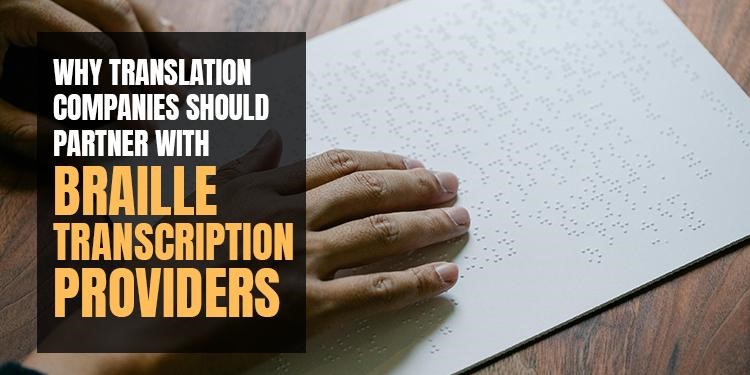
Translation companies play an important role in helping businesses communicate across languages. They help make content palatable to diverse cultures, regions, and audiences. However, modern communication is more than just language, as it also encompasses accessibility.
Have you considered whether translated content is accessible to those who depend on their hands rather than their eyes?
Customers are not just looking for translations of text. They are looking for content that can be read and understood by all. This is why braille services for translation companies are becoming increasingly important. By working with experts, organizations can extend their offerings and provide full accessibility solutions.
Expanding Services Beyond Language
Modern users are looking for more than simple translation. They are looking for content that can reach everyone, including people with visual impairments.
In providing the braille language service, translation companies can:
- Aid visually blind readers.
- Meet the accessibility requirements and comply with the compliance requirements.
- Provide inclusive content across various formats
- Enhance the value of their existing services
This expansion isn’t just about introducing a new product. It’s about strengthening the agency’s position in a highly competitive market.
Clients are increasingly seeking partners who provide complete solutions. If accessibility is part of the service, it reduces the need for multiple suppliers. It makes it easier and more efficient for customers.
Why Braille Expertise Is Specialized
Braille isn’t just the translation of text. It is a system with specific rules, regulations, and guidelines.
It includes:
- Language-specific braille codes
- Abbreviations and contracts
- Formatting rules to improve accessibility
- Adjustments to structure and layout
Due to these issues, it’s not practical for most translation firms to manage braille independently without proper training.
Small mistakes in braille may alter meaning or decrease accessibility. This is why many agencies decide to outsource braille transcription to experts in this field.
Specialists can accurately convert content while ensuring clarity and usability.
Benefits of Partnering with Braille Service Providers
Working with Braille Music and More experts can bring many benefits.
1. Accuracy
Specialists ensure the content is in line with proper braille standards. This helps reduce the chance of errors and improves the readability.
2. Efficiency
It is possible to complete projects more quickly without internal training or setup.
3. Scalability
Translation firms can manage larger projects without adding more internal burden.
4. Quality Assurance
Professional services include verification and proofreading to ensure accuracy.
5. Consistency
Collaboration with the same partner ensures that standards and formatting are maintained across projects.
These advantages allow organizations to provide secure braille translation services to firms without adding operational overhead.
Supporting Braille Localization
Localization is the adaptation of content to specific audiences. It is more than just translation.
Localization of braille ensures that the content is functionally and linguistically appropriate for the user.
This includes:
- The language of regional variations must be adapted to accommodate regional differences.
- Implementing the correct braille codes for every language
- Maintaining the same terminology
- Structured content to facilitate tactile reading
For instance, documents translated into Spanish require Spanish braille. Similarly, educational or technical documents may require specialized braille formatting.
In providing braille translation, translation companies can provide content that is not only translated but also accessible.
Use Cases for Braille Services
There is a growing demand for accessible content across industries. Translation companies can help meet this need by adding braille services.
Common usage cases include:
- Textbooks and educational materials
- Public service and government documents
- Information for patients and healthcare instructions
- Packaging for the product and user guides
- Corporate communication materials
Providing the braille-to-braille translation service enables agencies to serve a wider range of industries and clients.
This also allows you to develop projects that need accessibility compliance.
Meeting Client Expectations
The modern-day consumer is more aware of accessibility demands. Numerous organizations are trying to make their content accessible to all.
Translation projects typically contain requests for accessible formats.
Through partnering with braille providers, the agencies can:
- Complete solutions all in one location
- Enhance customer satisfaction
- Establish long-lasting relationships
- Chances to win larger contracts
The clients prefer agencies that also manage accessibility and translation. This makes project management easier and ensures uniformity.
Reducing Operational Complexity
In-house development of braille capabilities can be a challenge. It involves:
- Specialized training
- Technology and tools are the most important investment.
- Quality control procedures are ongoing.
For many organizations, this is not feasible for many agencies.
The decision to contract braille transcription enables companies to obtain expert assistance without increasing the workload of their internal staff.
This strategy assists agencies:
- Conserve time and resources
- Beware of costly mistakes
- Keep a focus on the primary services of translation
Outsourcing can also provide flexibility. Agencies can scale their services up or down depending on the project’s needs.
Strengthening Competitive Advantage
The field of translation is highly competitive. Offering extra services can help companies make a mark.
The provision of braille-based services to translation firms is a demonstration of:
- Engagement to communicate inclusively
- Capability to manage difficult projects
- Ready to meet accessibility standards
This makes the agency an innovative and trustworthy partner.
It also helps attract clients interested in accessibility for their projects.
Final Words
If your translation firm is seeking to increase its services and provide comprehensive accessibility solutions, joining forces with the right professionals is vital. Braille Music and More offers reliable, flexible, and trustworthy braille services tailored for international projects.
When you integrate professional braille services into your workflow, you will be able to provide clients with more than translation. It is possible to provide information that is accessible to everyone.
The next step is to take the first step towards inclusive communications and position your agency as a pioneer in global and accessible content solutions.